
-
Email info@annpnc.org
-
Address 848 N. Rainbow Blvd. #5486 Las Vegas, NV 89107, USA
Executive Director, Massachusetts Aggression Reduction Center, Bridgewater State University, Bridgewater, Massachusetts, USA.
*Corresponding author: Elizabeth Englander
Executive Director, Massachusetts Aggression
Reduction Center, Bridgewater State University, Bridgewater, Massachusetts, USA.
Email ID: ekenglander@gmail.com
Received: Apr 05, 2025
Accepted: May 09, 2025
Published Online: May 16, 2025
Journal: Annals of Pediatrics and Neonatal Care
Copyright: Englander E et al. © All rights are reserved.
Citation: Englander E. Cell phones, smartwatches and anxiety among elementary age children. Ann Pediatr Neonatal Care. 2025; 1(1): 1006.
In 2024, a study conducted on young children and their parents in two schools in Florida and Massachusetts examined cell phone and smartwatch ownership and their relationship to parents’ reported concerns about their children’s anxiety. Smartwatches have become common in elementary schools; and this study, conducted at the Massachusetts Aggression Reduction Center at Bridgewater State University, examined 61 students and 82 parents in grades 2 through 8. Results: subjects were more than twice as likely to report cell phone ownership (31.7%) compared to smartwatch ownership (14.1%). Anxiety was much more commonly reported for children owning cell phones, compared to either those who owned smartwatches, or those who owned neither.
Between 2023 and 2024, technological advances were uncharacteristically rapid and socially significant. In 2018, approximately $1.7 billion in sales were recorded for smartwatch purchases made with the intent of having children use them. It is projected that by 2032, $4.5 billion in sales will be recorded for smartwatches intended for use by children.
Smartwatches are being aggressively marketed as a safer alternative to cell phones for young children. Parents may also be drawn to smartwatches by media reports associating cell phone use with mental health challenges, including anxiety and depression. Cell phones in young children are associated with increases in anxiety, depression, and mental health challenges in general. They also exacerbate problems with excessive screen use and displacement of healthier social activities among young kids. For these reasons, smartwatches may be attractive as an alternative.
There is very little research on the behavioral impact of smartwatch use in children. Some positive associations have been noted. One 6-week study of children with ADHD found that smartwatches were helpful in reminding the children to keep focus on a task and to keep to a pre-planned schedule [5]. Another study used smartwatches to gather biometric data from smartwatches to significantly improve mental health diagnoses [8]. On the other hand, one study found that wearables (i.e., smartwatches) that gave continuous feedback about health status actually increased anxiety in users [11]. Anxiety has been associated with screen use in general, and particularly with social media use. Research at the Massachusetts Aggression Reduction Center has noted that high percentages of youth rate themselves as “unattractive” compared to social media images, and report anxiety when using social media [7]. Teens who use social media for longer hours per day report significantly more mental health problems, including depression and poor self-esteem [6]. Given that many studies to date have noted mental health problems associated with daily use of cell phones and screens in general, the question of whether or not smartwatches could be simply another “screen” that negatively affects young users remains a potential concern [2].
The current study compared cell phone and smartwatch users, and their mental health, in a sample of children in grades 2 through 8.
In this study examining smartwatch and cell phone use among elementary school-aged children, 143 subjects (61 students and 82 parents) in two elementary schools in Massachusetts and Florida were surveyed about cell phone use, smartwatch use, and concerns about mental health. Children were all enrolled in grades 2 through 8. For the anxiety variable, no formal diagnoses were measured; instead, parents were asked if they had any concerns about their child’s anxiety. These subjects were all surveyed in September and October of 2024 through use of an online survey. Students were surveyed during the school day and their parents were surveyed via links sent to the parents through email. If a student had more than one parent, respondents were asked to have only one parent complete the survey. If parents had more than one child at school, they were asked to select one to consider for the survey. Virtually all students in the relevant grades completed the survey; among parents, 64% of those who were sent the survey link ultimately completed it.
Demographics
Almost 58% of respondents were parents, while 43% were students. More than half (55.6%) of respondents were either female students or parents of female students; 44% were or were parents of male students; and .7% were or were parents of non-cisgendered students. (Gender of the responding parent was not assessed). Most subjects were in grades 2 through 5 (or parents of these students), but students as advanced as grade 8 responded to the survey.
Cell phone and smartwatch ownership
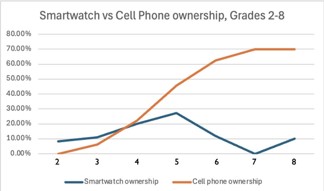
Overall, subjects were approximately twice as likely to report cell phone ownership (31.7%) compared to smartwatch ownership (14.1%). In younger grades (grade 2 and grade 3), smartwatch and cell phone ownership are similar. In grades 4 and 5, smartwatch ownership is slightly higher than or equal to cell phone ownership. After grade 5, cell phone ownership was significantly higher than smartwatch ownership. This suggests a transition from smartwatches to cell phones as children get older, particularly after grade 5.
Gender differences
Male students were more likely to report owning smartwatches (18% versus 3% of females). Fisher’s exact test showed that male students were eight times more likely to own a smartwatch compared to their female counterparts (OR=8.0, p<0.05).
In contrast, cell phone ownership showed more balanced adoption rates between the genders, with 59.1% of male students and 54.1% of female students reporting ownership (p=0.79), suggesting that gender disparities may be technology-specific rather than reflecting overall digital device access.
Mental health challenges
Parents of students in grades 2 through 6 were asked about mental health concerns for their child. Overall, among 82 parent respondents, 23(28%) reported that they were concerned about their child’s anxiety levels, or had sought professional help for their child’s anxiety. This measure of anxiety was then compared between cell phone owners, smartwatch owners, and non-owners. Cell phone owners were more likely to report anxiety, compared to smartwatch owners and non-owners.
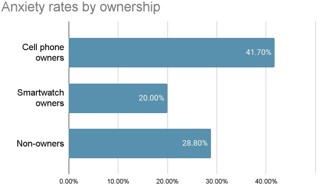
In this preliminary study, sample sizes (and thus power) were too low to permit statistical tests of significance for most differences noted. Nevertheless, this is the first study that has compared cell phone and smartwatch ownership in young children, to ascertain if any associations may exist for anxiety. This data suggests that cell phone ownership and smartwatch ownership may, in fact, be differentially associated with challenges with anxiety in young children. It was observed that anxiety was reported as lower in children who owned smartwatches, in contrast with those who owned cell phones.
Some limited research has found that smartwatches and smartphones are used fundamentally differently. There are a few studies comparing the experience of using smartwatches and cell phones, primarily conducted for marketing and product development purposes. One study found that smartwatch screens are better suited to quick, glanceable interactions, where essential information is prioritized [1]. Smartphones allow for more extended, detailed interactions [4]. Phones have larger displays with higher resolution, which common sense suggests would be superior for viewing images, especially photographs [12]. Passive consumption of content (e.g., scrolling through photos) often leads to negative comparisons and FOMO (fear of missing out), which are strongly linked to anxiety in children [9].
The obvious difference in screen size suggests that photographs posted on social media, a source of anxiety for teens, may be less of a concern for children wielding smartwatches. While research on smartwatch use in young children is in its infancy, other studies have examined the link between images and mental health in young children particularly images on social media. For children aged 12–15, spending more than three hours daily on social media was associated with a higher risk of mental health issues such as depression and anxiety. Younger children (under 11) using platforms like Instagram or Snapchat were more likely to engage in problematic digital behaviors (e.g., forming online-only friendships or visiting inappropriate sites), increasing risks for mental health challenges [3]. Taken together, the research on anxiety, social media, and images in children and adolescents suggests that smaller screens that restrict such activities may be a viable alternative for parents seeking technology that permits them to keep in contact with their children, without risking increased anxiety, depression, or social skills challenges. However, more research, on larger samples, is needed to confirm and replicate these findings.